


Why Retrofitting Won’t Rescue 50-Seat Flying in the US
For decades, the strength of the United States air network rested on a simple but powerful promise: wherever you lived, there was a way in. Secondary cities, regional airports and smaller communities were connected to the country through frequent air service operated by regional aircraft.
Today, that system is under pressure.
As outlined in our previous analysis, Reinvigorating Regional Air Connectivity in the United States, the gradual retirement of 50-seat regional jets like the CRJ200 and ERJ145 is accelerating, with no new build replacement aircraft in production by these manufacturers.
Maintaining ageing fleets is becoming increasingly costly, while hundreds of regional routes have already disappeared from the United States’ network. Yet one conclusion has emerged clearly from operators, analysts and market data alike: the demand for 50-seat flying has not gone away.
What has changed is what travellers expect in terms of passenger experience.
A demand that has evolved, and a 50-seat segment still relevant
Airlines are still investing in smaller aircraft around the 50-seat threshold to preserve frequency and sustain access to thinner markets where larger aircraft simply do not make sense.
The rise of three-class cabins in this category tells the story. Where once a single-class layout was tolerated, airlines are now prioritising differentiated cabins – first class, premium economy and economy – to serve all types of travellers, protect yield and remain competitive on regional routes feeding major hubs.
This explains the recent wave of conversions of ageing regional jets into 50 and 40-seat configurations. A clear signal of how critical the 50-seat mission remains.
However, there is a growing gap between what airlines are trying to achieve and what legacy aircraft can deliver in the long term.

The limits of refurbishment
Refurbishing a cabin can improve passenger experience… to a certain extent. Cabin space is structurally constrained, overhead bins cannot consistently accommodate standard carry-on baggage for all passengers, and seating density is reduced to enable premium cabins. In the case of the CRJ200, achieving a three-class layout would cap capacity at around 41 seats, significantly diluting revenue potential compared with a purpose-designed 50-seat three-class aircraft.
Besides, what refurbishing cannot do is change an aircraft’s fundamental architecture or accumulated flight cycles. All aircraft in the 50-seat-jets category are on average over 20 years old, leading to increased maintenance costs, and lower productivity.
Even without these economic constraints, the pool of airworthy airframes suitable for conversion is finite, limiting the scalability of this strategy.
In short, these aircraft can be refreshed, but they cannot be reinvented.

A different starting point: designing for today’s regional mission
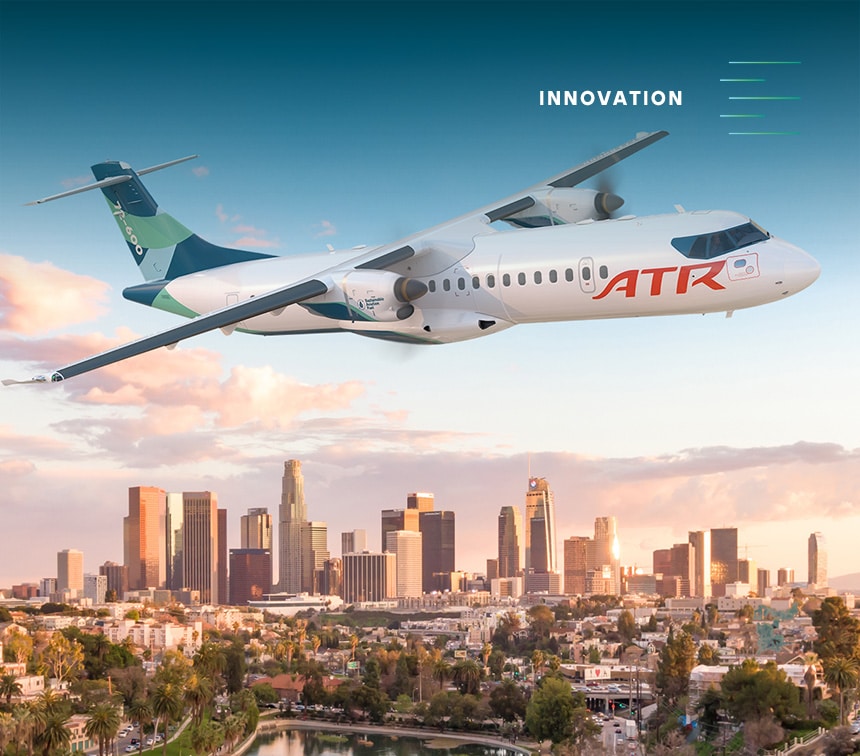
ATR’s approach begins from a different premise: if the US still needs 50-seat aircraft – and all evidence suggests it does – then the replacement must be designed specifically for today’s expectations, not yesterday’s heritage.
The ATR three-class 50-seat configuration is designed around a clear objective: to make premium regional travel comfortable, modern, and economically viable.
The proposed layout – combining first class, premium economy and economy – is enabled by a wider cross-section, a taller cabin and generous overhead storage. In this configuration, every passenger can bring a full-size cabin bag on board, eliminating one of the most persistent friction points in regional travel.

Comfort extends beyond seating. The cabin is conceived as a modern regional environment: connectivity, light, space and boarding efficiency – including the option of a forward door compatible with boarding bridges – all aligned with mainline passenger expectations.
And crucially, this is not achieved by sacrificing economic discipline. It is enabled by it.

When comfort and economics finally align
What fundamentally distinguishes ATR’s proposition is that passenger comfort is not achieved at the expense of economics; the two are aligned by design.
On missions typical of United States regional networks, ATR turboprops deliver up to 45% lower fuel burn and CO₂ emissions compared with ageing 50-seat jets. This translates directly into significant operating cost advantages, and as much as $2 million in additional annual profitability per aircraft.
With these advantages, ATR aircraft require up to eight fewer passengers to break even on a typical route – a decisive factor on thinner markets where frequency matters more than scale.
Lower costs allow airlines to sustain premium cabins without pricing themselves out of the market. Lower costs make it viable to restore routes that have disappeared. And lower costs make regional mobility more resilient over time.

Building the next chapter of US regional aviation
The retirement of the 50-seat regional jets fleet is often discussed as a technical or fleet-planning problem. In reality, it is something more consequential: a once-in-a-generation opportunity to redefine what regional air transport should deliver.
The question is no longer whether 50-seat aircraft have a future in the US. The question is whether the industry will continue to rely on stop-gap conversions and ageing platforms, or embrace aircraft designed to make regional connectivity both comfortable and affordable again.
The stakes are high. Regional aviation is not a niche, it is the connective fabric of the US air transport system. And rebuilding it will require aircraft that are not simply smaller, but smarter.
Share this article