
The Realistic Path to Low-Emission Regional Aviation
Why the Future of Aviation Takes Time and What We’re Doing About it
Innovation in aviation does not follow the pace of ambition alone. It is shaped by one overriding principle: flight safety. Every new technology must be proven, integrated and certified before it can enter service – a process that takes time, rigour and discipline.
This reality often creates a gap between what can be imagined and what can be delivered in the near term. But it also defines how meaningful progress happens in this industry: step by step, through testing, validation and continuous learning. Each demonstration, each insight gained, is a step forward.
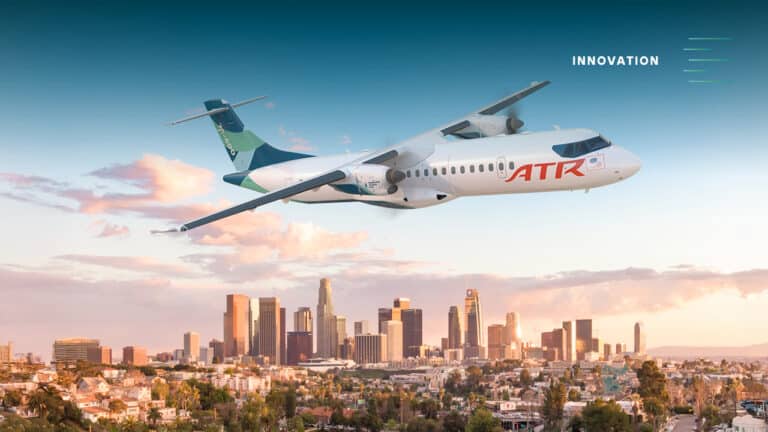
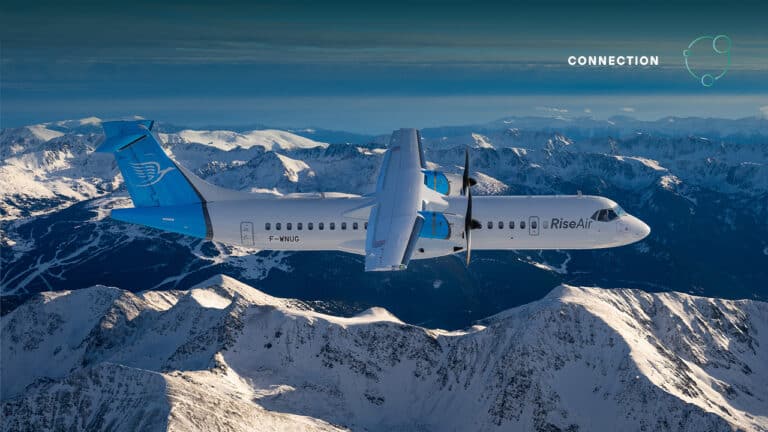
At ATR, this principle has guided our approach for 45 years. While maintaining an uncompromising commitment to safety, we have consistently prioritised fuel efficiency, low emissions and operational relevance over speed or short-term trends. Today, ATR aircraft burn 45% less fuel than similar-size regional jets, already making them the benchmark for responsible regional aviation. Across Europe alone, replacing regional jets with turboprops could save around 1 million tonnes of CO2 emissions every year.
And it matters. Because decarbonisation is not only about future breakthroughs, it is also about scaling solutions that exist today.
In parallel, as ATR aims to remain at the forefront of decarbonisation and continuously improve its environmental performance, preparing the next step is essential. In this context, Clean Aviation plays a specific role. As a European research and innovation programme bringing together aircraft and equipment manufacturers, research centres and regulators, its objective is to accelerate low-emission aviation technologies by exploring, demonstrating and measuring what can realistically be achieved at aircraft level.
For regional aviation, it marks a shift: from discussing possibilities to building evidence.
Clean Aviation: Turning Exploration into Structured Progress
ATR’s leadership of the HERACLES and DEMETRA projects reflects a clear and deliberate approach: innovation must be both ambitious and grounded in reality.
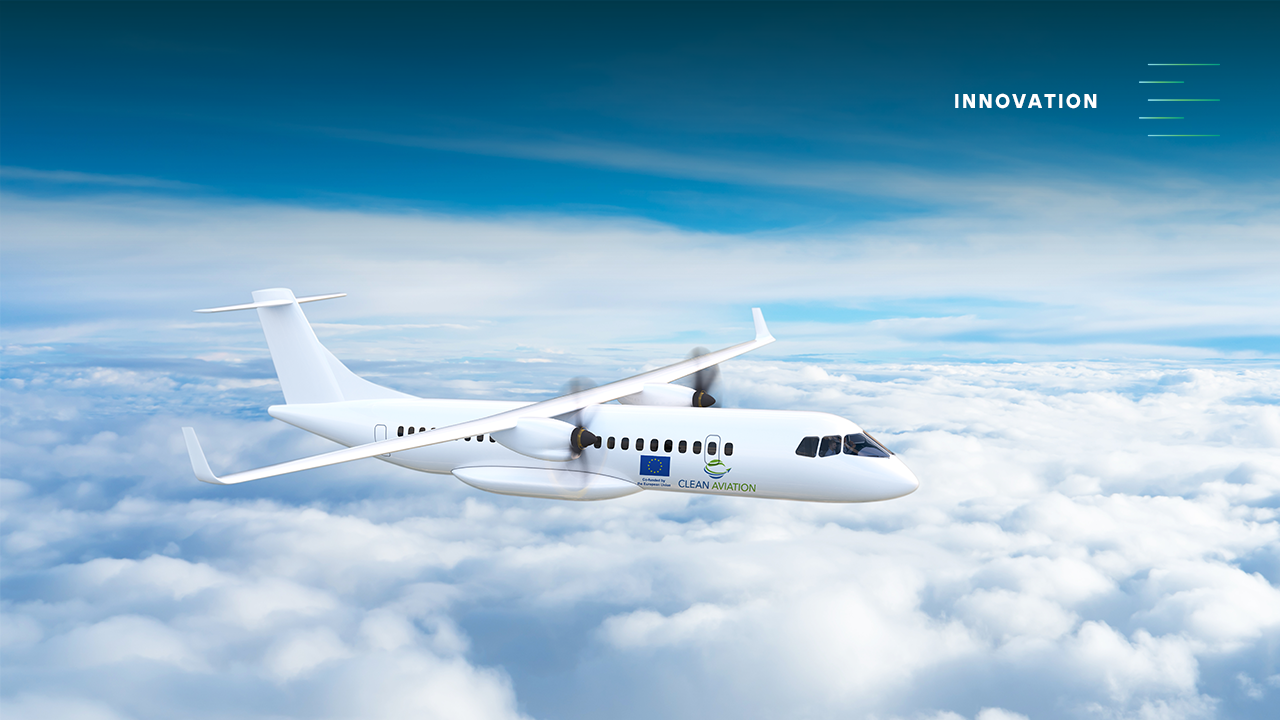
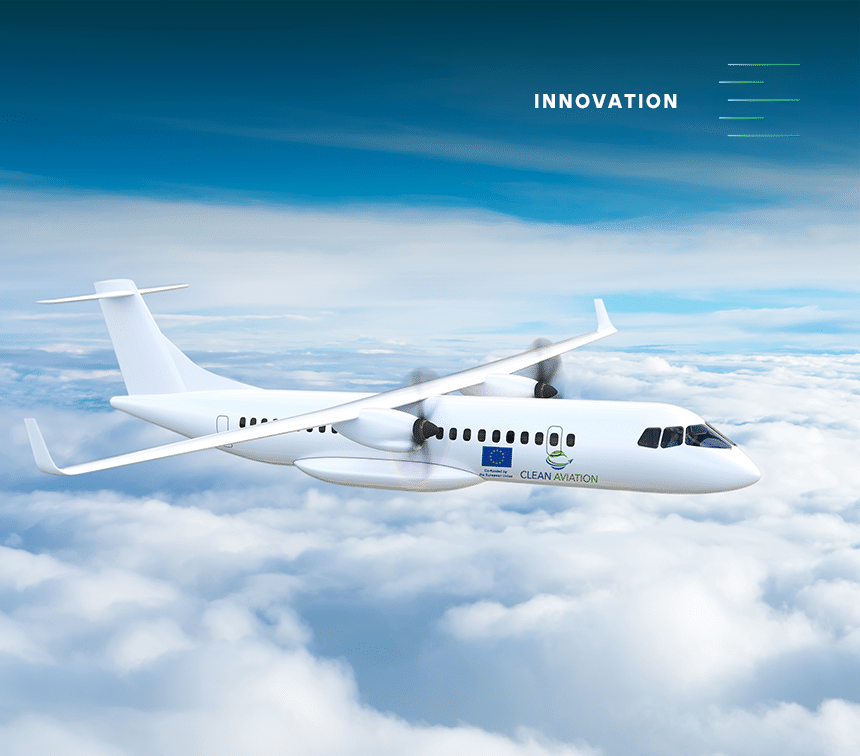
At the core of these projects is the Ultra-Efficient Regional Aircraft (UERA) concept, targeting a 30% reduction in CO₂ emissions compared with today’s ATR 72-600. This ambition relies on the combination of several advanced technologies, including hybrid-electric propulsion, next-generation propellers, an optimised airframe and highly integrated systems.
But the most important aspect is not any single technology – it is how they are brought together and integrated into the complete aircraft, with a clear operational environment in mind.

Clean Aviation does not assume a single solution from the outset. Instead, it focuses on maturing the most credible technological pathways to the point where informed industrial decisions can be made. Aircraft and equipment manufacturers of all sizes, research centres and regulators are aligned to ensure that development, integration and certification evolve together in parallel, highlighting that certification must progress hand in hand with innovation, as a challenge just as fundamental as the technologies themselves.
This reflects a conviction that ATR has long held: reducing emissions cannot come at the expense of flight safety, connectivity, certification or economic viability. The objective is therefore not to promise a breakthrough, but to build a pathway towards one, based on evidence.
Proof Over Promises: Why Demonstration Is Essential
Innovation becomes meaningful when demonstrated on an integrated aircraft platform. This is why the ATR 72-600 has been selected as the flight test platform for hybrid-electric propulsion within the DEMETRA project. As the most widely operated aircraft in its segment, it offers a representative and operationally relevant environment to evaluate new architectures under real conditions. The purpose of this work is not to validate a predefined answer. It is to reduce uncertainty.
By testing technologies on the aircraft, teams can assess performance, safety, system integration, certification pathways and operational impact in a comprehensive way. Demonstration becomes a decision-making tool, enabling the industry to understand not only what is possible, but what is viable.
Because ATR aircraft are certified under EASA’s CS-25 large aeroplane requirements – the same framework used for all commercial airliners, up to and including wide-body aircraft such as the Airbus A380 – these demonstrations go beyond regional aviation. They contribute to shaping safety and certification approaches for future technologies across a broader range of aircraft.
This is how innovation becomes scalable.

Advancing Without Compromising Credibility
Hybrid-electric propulsion is one of the most promising pathways currently being explored within the regional pillar of Clean Aviation. If validated at aircraft level, it could deliver benefits that matter directly to operators: reduced fuel consumption, lower operating costs, improved noise performance and greater resilience to fuel price volatility.
But these benefits are not assumed, they must be proven.
Integrating hybrid-electric systems raises complex challenges: high-voltage architecture, thermal management, safety and certification, as well as new maintenance and operational considerations. Infrastructure will also play a role, from energy supply to airport capabilities.
Addressing these realities is not a limitation. It is what ensures that future solutions will work in the real world.
At ATR, this approach is deliberate. We do not position innovation as a promise detached from operational constraints. We approach it as a process: explore, test, measure, and decide. Because credibility is built not only on what you aim to achieve, but on how you get there.

Building on What Already Works
One of the strengths of regional aviation today is that significant progress has already been achieved.
ATR aircraft already deliver the lowest emissions in their segment, thanks to their turboprop architecture and continuous efficiency improvements. This creates a strong and credible starting point for further innovation.
It also shapes how we think about the future. Decarbonisation is not about reinventing everything overnight, nor about promising “guilt-free” flying in the short term. It is about combining what works today with what can realistically be improved tomorrow.
This is why the work conducted through HERACLES and DEMETRA, as well as through PHARES and OSYRYS, is directly connected to ATR’s long-term roadmap, including the EVO, our next-generation aircraft concept targeted for entry into service around 2035.
As technologies mature, each will be rigorously assessed based on performance, certification readiness, operational impact and economic value. Only those that demonstrate clear and measurable benefits will be carried forward.
In this context, hybrid-electric propulsion is not a fixed outcome. It is a credible pathway under validation.
From Ambition to Evidence
After years of discussion about the future of aviation, the focus is shifting.
The challenge is no longer to imagine new technologies, but to prove which ones can deliver – safely, efficiently and at scale.
At ATR, this is the path we have chosen: to build on proven efficiency, to explore new solutions with rigour, and to turn ambition into measurable progress.


The HERACLES/DEMETRA project is supported by the Clean Aviation Joint Undertaking and its members.
Funded by the European Union, under Grant Agreement No 101256955. Views and opinions expressed are however those of the author(s) only and do not necessarily reflect those of the European Union or Clean Aviation Joint Undertaking. Neither the European Union nor Clean Aviation JU can be held responsible for them.
Share this article